TRACING THE ORIGINS AND LINEAGE OF THE WANGA MUKULU KINGDOM
The history of the Wanga Mukulu Kingdom is deeply rooted in oral traditions and evolving historical interpretations that seek to explain the origins and migration of the Wanga people. While conventional narratives identify Wanga as the founding figure of the Wanga Kingdom, some scholars extend this lineage further back, linking it to ancient civilizations. According to these accounts, the ancestors of the Wanga people may have originated during the era associated with ancient Egyptian rulers, under the leadership of a figure known as Makata. Their migration is believed to have traversed regions such as Cameroon and Ethiopia, guided by leaders including Simbi and Nangwera.
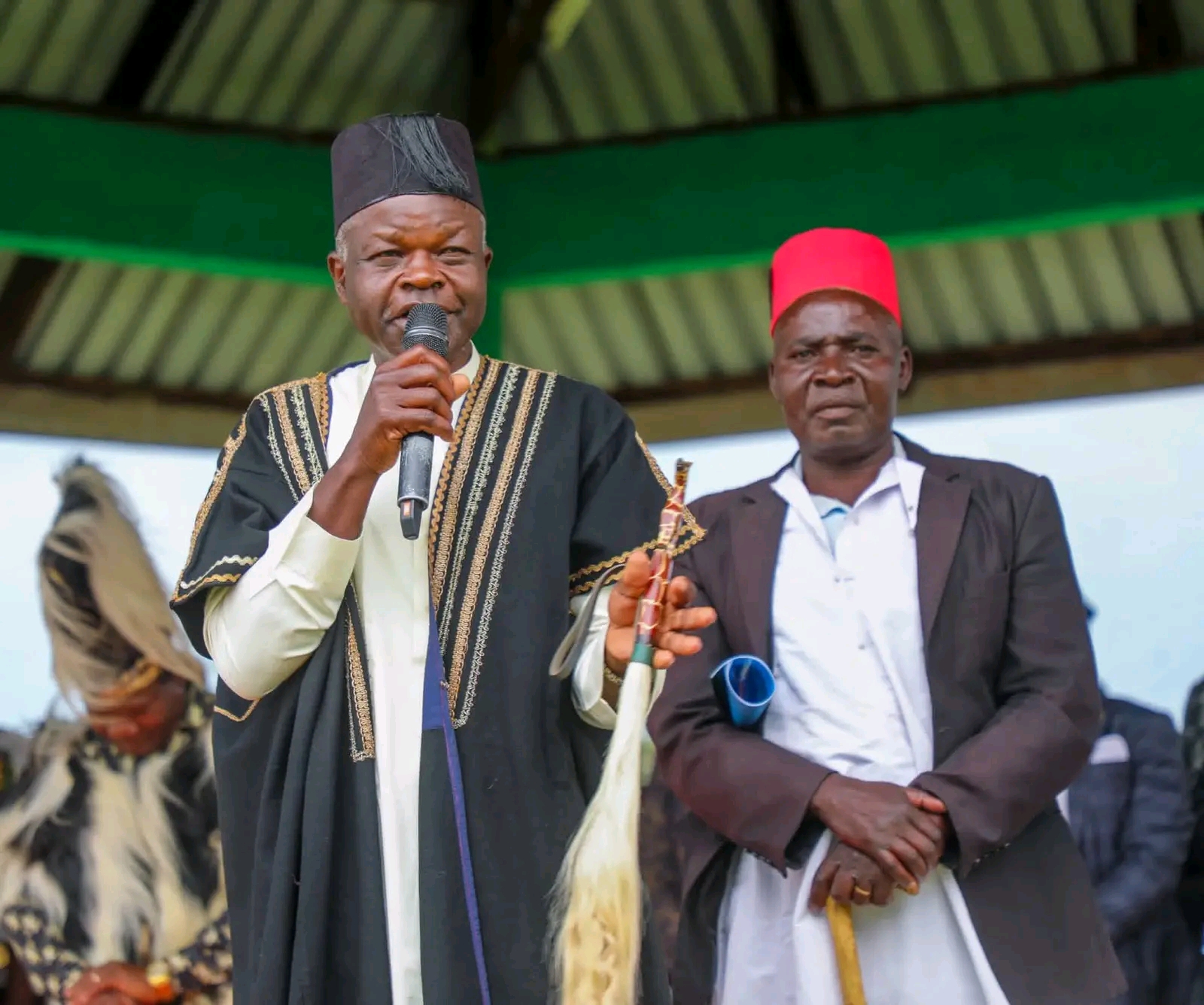
Nabongo Maurice Rapando II, son of William Wambani, the current reigning king of Wanga Mukulu Kingdom
As the migratory journey progressed, the community is said to have settled temporarily in present-day Uganda, where they came under the influence of various Buganda monarchs. Among those referenced in oral accounts are kings such as Muteesa, Kamaanyi, Mwanga (Muwanga), Mbwoli, and Muwanga II. These interactions are thought to have shaped aspects of their governance systems and cultural organization before their eventual movement into present-day Kenya.
A significant phase in this historical trajectory is marked by the settlement of Wamoyi in Ibanda, within the Samia region of Uganda. His son, Muwanga III, is believed to have migrated in the 10th century to Lela in Nyanza, Kenya. Muwanga III had several sons—Khabiakala, Wamoyi, Wanga, Wekhoba, Mukoya, Mutende, and Sakwa—who dispersed across different regions in search of suitable settlement areas. This dispersal played a critical role in shaping the distribution and expansion of related communities across western Kenya.
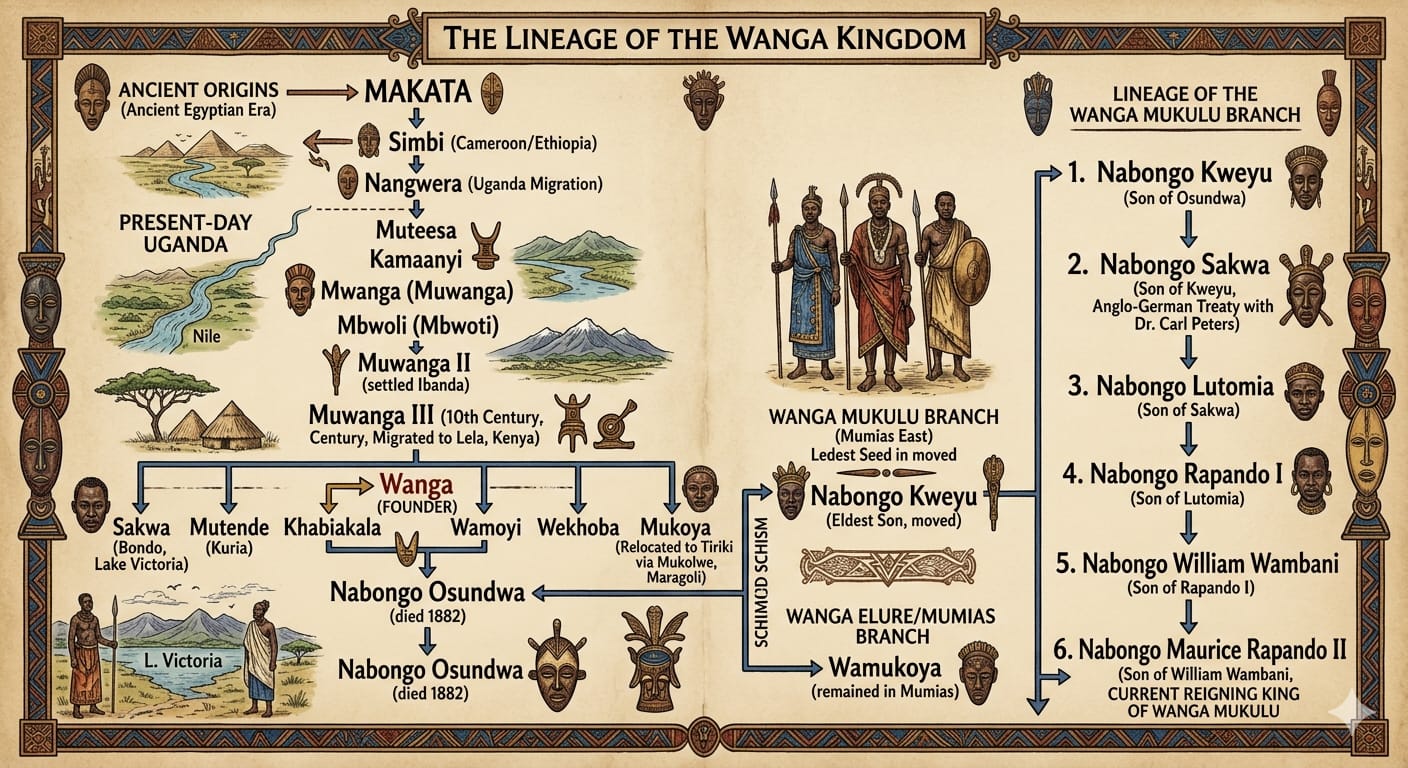
Among these descendants, Sakwa is said to have migrated to Bondo along the Lake Victoria basin, while Mutende moved southwards to settle in Kuria. The remaining sons—Wamoyi, Wanga, Wekhoba, and Mukoya—relocated to Tiriki following an invitation from their cousin Mukolwe, who had earlier established himself in Maragoli. It is from this group that Wanga is believed to have later moved westward independently, eventually settling in Imanga, in present-day South Wanga within Mumias West sub-county.
HISTORICAL OVERVIEW AND DUAL ROYAL LINEAGES OF THE WANGA KINGDOM
The early Wanga people are understood to have coexisted in Wanga Lureko, in present-day Mumias Town, where the royal court and cultural life were initially centralized. During this period, the community maintained a single royal reburial shrine at Eshiembekho in Matungu, which served as a sacred site for ancestral rites and royal interments. This unity continued until the death of Nabongo Osundwa, after which a significant succession shift led to the emergence of two distinct royal branches within the Wanga monarchy.
Following the succession dispute, Crown Prince Kweyu relocated from Wanga Lureko to establish what became the Wanga Mukulu line in present-day Mumias East. In response to this transition, the Eshimuli site within the MSC Nucleus Estate was established as the new royal reburial shrine for the Wanga Mukulu branch. This marked a formal separation of royal sacred spaces and governance structures between the two emerging houses of the Wanga Kingdom.
Despite the split, both branches have continued to preserve their royal traditions and cultural identity, maintaining parallel lines of leadership that trace their origins to the same ancestral foundation in Wanga Lureko.
CURRENT REIGNING NABONGOS
- Nabongo Peter Mumia II, son of Nabongo Shitawa, son of Nabongo Mumia I (Wanga Lureko / Elureko line)
- Nabongo Maurice Rapando II, son of Nabongo Japheth William Wambani, son of Nabongo Rapando I (Wanga Mukulu line)
These two reigning monarchs represent the continuity of the Wanga royal heritage, each presiding over their respective lineages while preserving the broader cultural legacy of the Wanga Kingdom.
Lineage of the Wanga Mukulu Branch
- Nabongo Kweyu, son of Nabongo Osundwa
- Nabongo Sakwa, son of Kweyu, noted for signing the Anglo-German Treaty with Dr. Carl Peters
- Nabongo Lutomia, son of Sakwa
- Nabongo Rapando I, son of Lutomia
- Nabongo William Wambani, son of Rapando I
- Nabongo Maurice Rapando II, son of William Wambani, the current reigning king of Wanga Mukulu
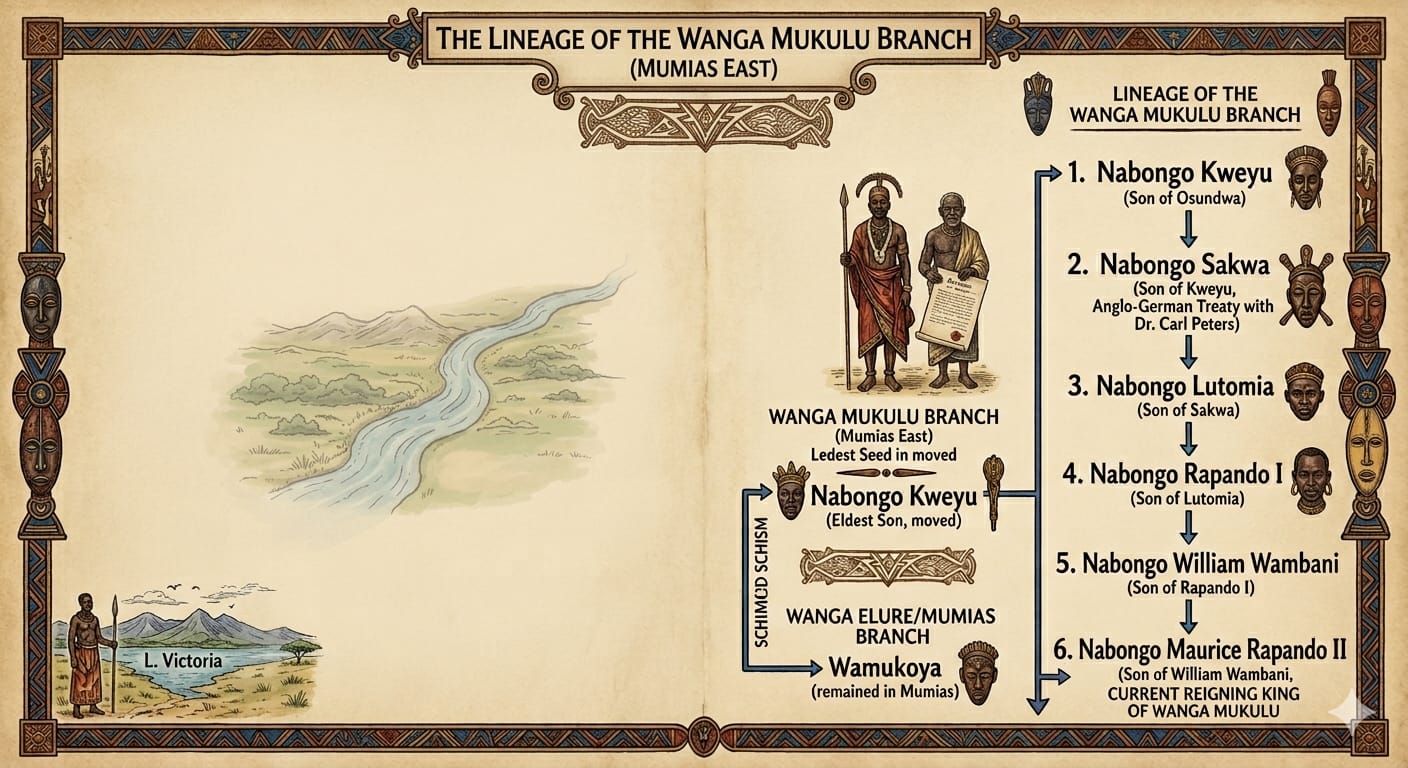
This lineage underscores the continuity of leadership within the Wanga Mukulu Kingdom, reflecting a rich heritage shaped by migration, adaptation, and enduring cultural identity.